How to Read a Gemstone Certificate: A Real Example, Line by Line
When you buy an expensive gemstone, the certificate is your proof of what you're paying for. Many buyers, though, find the report hard to read. Below we walk through a real certificate for a blue sapphire from our stock, line by line.
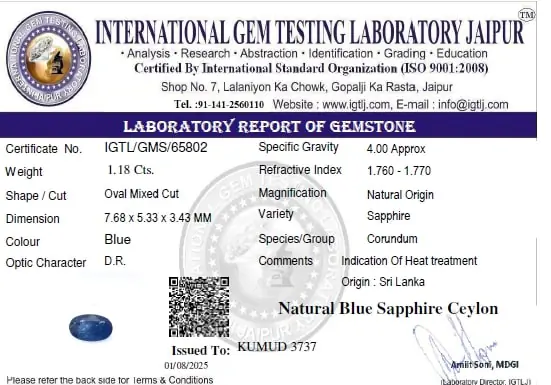
The example: what this certificate says
| Field on the report | What it says | What it means |
|---|---|---|
| Certificate No. | IGTL/GMS/65802 | The unique report number. Use it to verify the report with the lab. |
| Weight | 1.18 cts | Carat weight. One carat = 0.2 gram. Weigh your stone and check it matches. |
| Shape / Cut | Oval mixed cut | The outline (oval) and cutting style. "Mixed cut" combines brilliant facets on top with step facets below, and is common for coloured stones. |
| Dimension | 7.68 × 5.33 × 3.43 mm | Length × width × depth. These should match your stone to within a fraction of a millimetre. |
| Colour | Blue | The colour seen by the gemmologist. |
| Optic character | D.R. | Doubly refractive: light splits into two rays inside the stone. Corundum (sapphire and ruby) is doubly refractive. Glass is not. |
| Specific gravity | 4.00 approx. | Density compared with water. Corundum is about 4.00, which helps rule out many lookalikes. |
| Refractive index | 1.760 – 1.770 | How strongly the stone bends light. This range is typical of corundum. |
| Magnification | Natural origin | Under the microscope, the inclusions (tiny internal features) look like those formed in nature, not in a laboratory. |
| Variety | Sapphire | The trade name of the stone. |
| Species / Group | Corundum | The mineral family. Ruby and sapphire are both corundum. |
| Comments | Indication of heat treatment | The stone shows signs of having been heated to improve its colour or clarity (see below). |
| Origin | Sri Lanka | The lab's opinion of the country where the stone was mined ("Ceylon" is the old name for Sri Lanka). |
| Conclusion | Natural Blue Sapphire Ceylon | The lab's summary identification. |
Natural, treated or synthetic: the most important lines
- Natural means the stone formed in the earth, not in a laboratory.
- Treated means a natural stone has been improved after mining. Heating is the most common treatment for sapphire and ruby. It's permanent, widely accepted in the trade, and doesn't make the stone "fake". It should, however, always be disclosed, and unheated stones of the same quality cost more. In our example, the comment "Indication of heat treatment" is that disclosure.
- Other treatments are different products and must be clearly named. Examples include lead-glass-filled ruby (much less durable and far lower in value), oiling of emeralds (common, but it should be disclosed), diffusion and dyeing. See gemstone treatments explained.
- Synthetic (lab-created) stones have the same chemistry as natural ones but were grown in a laboratory. A good report will say so.
How to check a certificate against your stone
- Match the numbers. Weigh the stone (carats) and measure it. The weight and dimensions should match the report.
- Match the photo. Compare the photo on the report with your stone's colour and shape.
- Check the report number. Contact the laboratory with the certificate number, or scan the QR code printed on the report, to confirm it is genuine. IGTL Jaipur's contact details and website (igtlj.com) are printed on the report.
- Read the comments line. That's where treatments are disclosed.
- Check who issued it. The lab's name, address and contact details should be printed on the report, and the stone should be identified by species and variety, not just "natural gemstone".
Red flags
- A "certificate" with no test results (no refractive index, no specific gravity), only a photo and a name.
- Weight or dimensions that don't match your stone.
- No mention of treatment on a ruby or sapphire at a very low price. Most rubies and sapphires on the market are heated, so silence can hide a treatment.
- The seller won't share the report number before you pay.
How Kumud handles certificates
Every loose gemstone on our website shows its lab, certificate number and certificate image on the product page ("View Certificate"). Our stones are tested by International Gem Testing Laboratory (IGTL), Jaipur.
Frequently asked questions
What does "Indication of heat treatment" mean on a gem certificate?
It means the lab saw signs that the stone was heated to improve its colour or clarity. Heating is common and accepted for sapphires and rubies, and it is permanent. It does affect value, though, and should always be disclosed.
What does D.R. mean on a gemstone report?
D.R. stands for "doubly refractive": light splits into two rays as it passes through the stone. Sapphire, ruby, emerald and many other gems are doubly refractive. Glass and garnet are not.
What refractive index should a blue sapphire have?
About 1.76 to 1.77. That's the typical range for corundum, the mineral that blue sapphire, yellow sapphire and ruby are made of.
Is a heated sapphire natural?
Yes. A heated sapphire is still a natural sapphire that formed in the earth. It has simply been heated after mining. The certificate should say "natural" and disclose the heat treatment.
How do I verify a gemstone certificate?
Check that the weight and dimensions match your stone, then confirm the certificate number with the issuing laboratory, either by scanning the QR code on the report or by contacting the lab directly.
Browse our certified blue sapphires, yellow sapphires and rubies. Each product page shows its certificate.